Explore our library, where insights, press articles, and events are organized by tags, making it easy to find relevant topics.
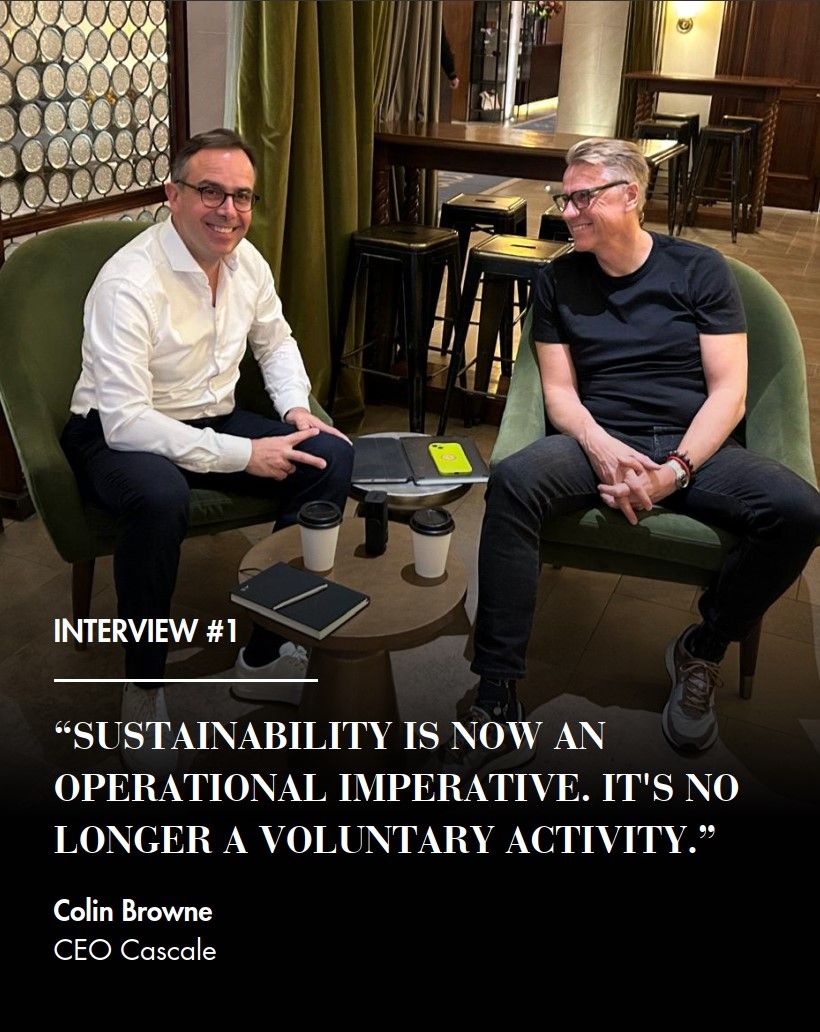
linkedin Interview #3 - Colin Browne; CEO, Cascale
How #Apparel #Sourcing Has Changed — and Why #Sustainability Is an #Operational #Imperative These were the core themes of my recent conversation with Colin Browne CEO of Cascale (formerly the Sustainable Apparel Coalition or SAC). Colin is a true industry veteran, starting his career as a buying and sourcing manager in Asia in the late ‘80s. I first met him about ten years ago in Hong Kong during his tenure as VP and Managing Director of Asia Sourcing at VF Corporation Corporation , where he was a key architect of supply chain strategy in the apparel industry.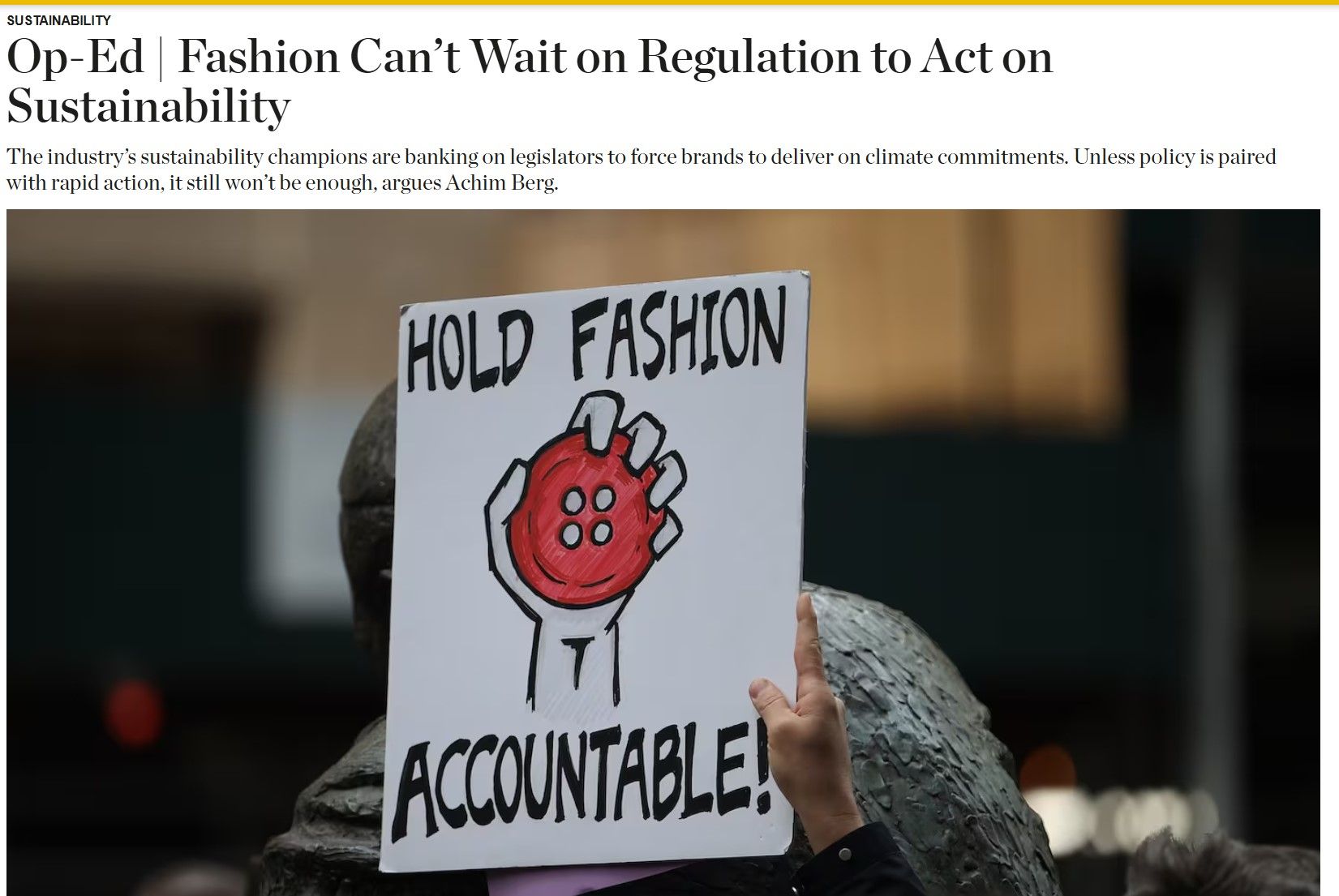
press June 2024 Op-Ed: Fashion Can’t Wait on Regulation to Act on Sustainabi...
businessoffashion.comIn his Op-Ed, Achim comments on the current state and progress of sustainability in the fashion industry and what regulation can do for it (or not).
Fashion's sustainability efforts have grown in importance, yet significant challenges remain as consumption, emissions, and pollution continue to rise. While many hope that regulation will drive change by forcing brands to deliver on climate commitments, there is concern that relying on slow-moving policies will further delay progress. Industry leaders, especially its “super winners,” must take responsibility and accelerate their sustainability initiatives, or risk being overtaken by more innovative competitors.
press May 2025 How luxury giant LVMH threatens to fall into Trump's customs...
WirtschaftsWoche by Katharina KalinkeAchim comments on the impact of tariffs and shifting dynamics in America’s role for luxury
Trump’s imposition of new tariffs is placing renewed pressure on European luxury houses. While no brand is seriously considering relocating production to the US, LVMH - already operating a manufacturing site in California - is the only one exploring an expansion of its American operations. The move aligns with Trump’s pro-domestic manufacturing narrative but remains largely symbolic, as Achim notes, given that a meaningful return of textile production to the US would require full automation - a challenge that has repeatedly proven unfeasible in the past. Beyond tariffs, Achim highlights the growing impact of luxury’s democratization, with middle-class consumers being the first to scale back spendings amid economic uncertainty. Even if tariffs prove temporary, he adds, they fail to restore the level of investment security needed. Mounting fears of a global recession and eroding investor confidence are steadily weakening America’s standing as a long-term growth engine for the industry.
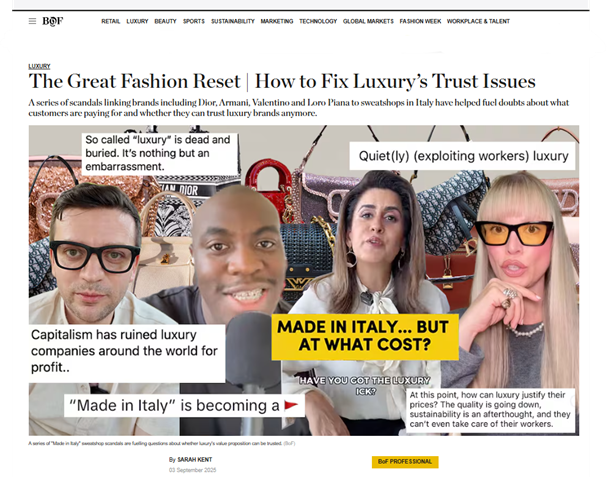
press September 2025 The Great Fashion Reset - How to Fix Luxury’s Trust Issues
BoF by Sarah KentAchim comments on recent scandals exposing luxury supply chains and its impact on luxury perception and consumer trust
The luxury industry is currently facing a structural crisis. Price hikes far beyond inflation have raised consumer doubts about value and trust. Slowing sales, management missteps and recent "Made in Italy" court cases exposing sweatshops, have further damaged the industry's image. Achim notes that luxury brands have been chasing volumes without strengthening supply chain controls, often turning a blind eye. He highlights that this is especially shocking for small-volume, high-margin companies, whose higher prices are justified by promises of exceptional quality.
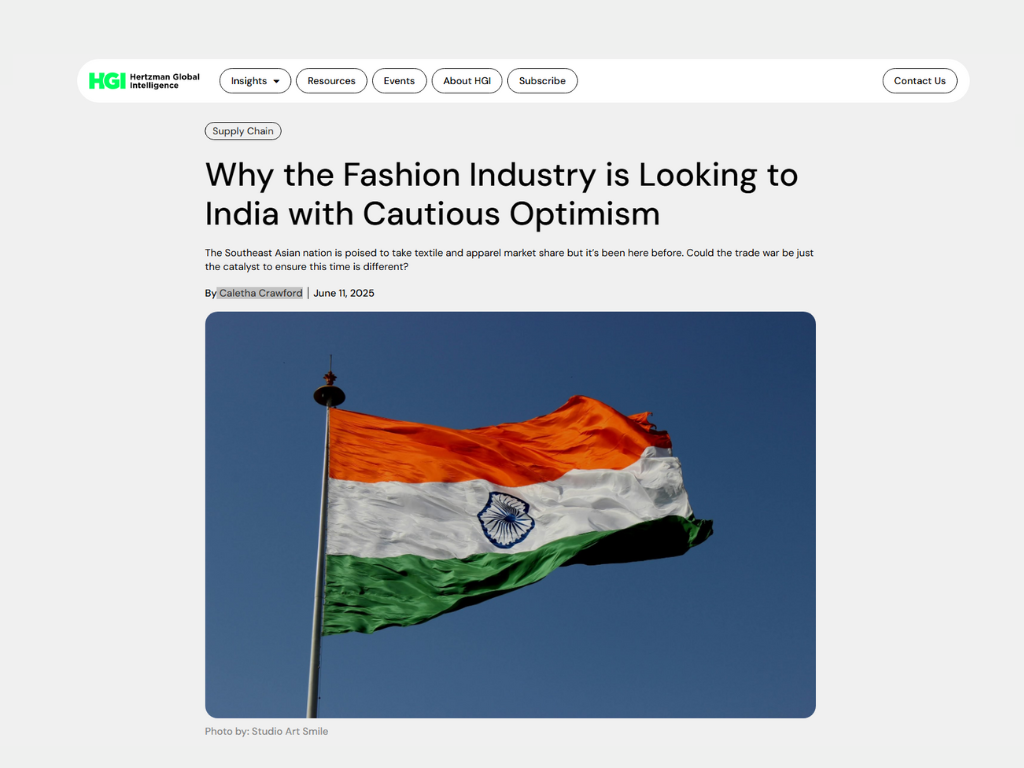
press June 2025 Why the Fashion Industry is Looking to India with Cautious O...
Hertzman Global Intelligence by Caletha CrawfordAchim comments on the renewed discussion about India’s potential as a sourcing market, particularly in light of trade and price policies.
He notes that a big breakthrough in India has often been predicted but never delivered. The article highlights both the country's potential and the challenges it faces, a perspective which Achim shares. In his view, India has most of what it takes to succeed; however, the challenge lies in organizing these strengths holistically. The current mix of trade shifts and new investments may finally create the conditions for progress. Achim concludes that India will only turn its sourcing potential into sustained growth if it secures reliable trade deals that provide fashion brands with confidence in stable costs and predictable market access.
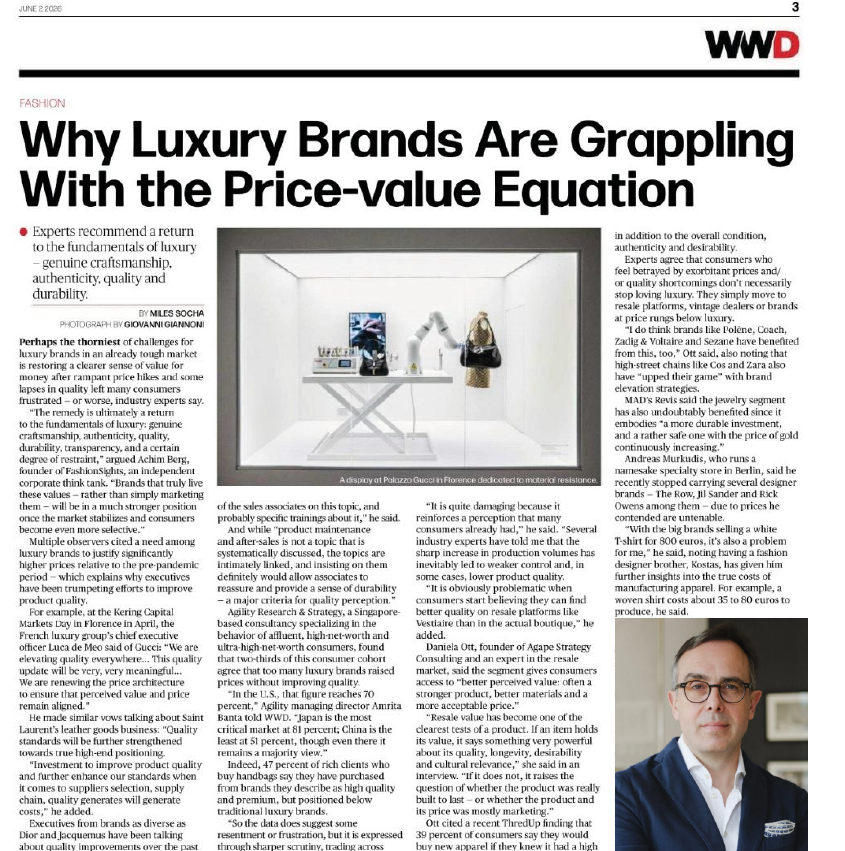
press June 2026 Luxury Brands Are Grappling With Issues of Price, Quality an...
WWD by Miles SochaAchim diagnoses luxury's self-inflicted crisis and sets out what a recovery demands.
Luxury is facing a credibility reckoning of its own making. Years of aggressive pricing, compounded by growing consumer scrutiny over craftsmanship and supply-chain practices, have deepened a mistrust many consumers already held. Post-pandemic buyers are no longer spending on aspiration alone - they are demanding justification. Achim’s prescription is a return to the fundamentals of luxury and restraint: craftsmanship, quality, and transparency. Brands that merely market these values rather than live them, he warns, will be exposed once the market stabilizes and consumer selectivity sharpens.
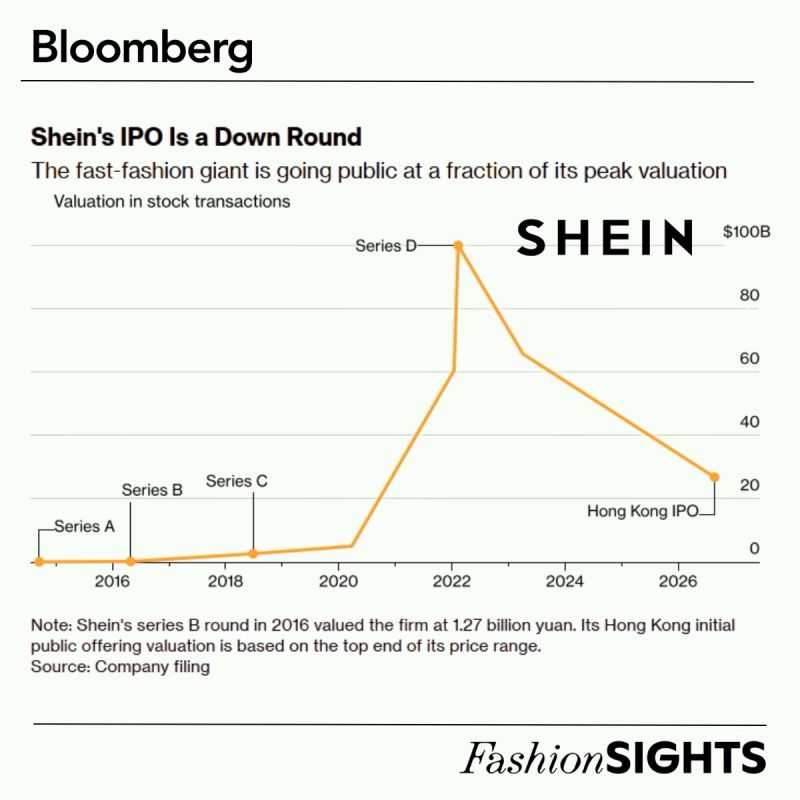
linkedin August 2026 How SHEIN's investors missed their exit window
SHEIN certainly doesn't need the cash. The company has almost $15 billion in reserves. The answer is that VC and PE funds are ultimately judged by realized returns, not paper valuations. Liquidity has likely become more important than maximizing the headline valuation. The business itself also deserves a more balanced assessment. The de minimis changes in the US, regulatory scrutiny in Europe and geopolitical tensions will undoubtedly make growth more difficult. But SHEIN created one of the very few genuine business model innovations our industry has seen over the past three decades. Inditex pioneered the push-pull model - SHEIN invented the manufacturer-to-customer model: digitally connecting consumer demand with a highly responsive manufacturing ecosystem. The result is lower inventories, faster product cycles, exceptional capital efficiency and an unprecedented level of scalability. What impressed while reading the IPO prospectus is their ambition to become the "AWS of fashion" as Bloomberg put it. Rather than simply selling more products, SHEIN increasingly wants to provide its supply chain, technology and manufacturing capabilities to other brands. Another point that is often overlooked is hashtag#profitability. Today's discussion is focused on slowing growth. But businesses of this scale have a choice between maximizing growth and maximizing earnings. Given its scale, tech platform and highly efficient operating model, SHEIN has significant untapped potential to improve its bottom line. The current margin may therefore understate the company's long-term earnings power. Ironically, that is precisely why the IPO could become an attractive investment opportunity. Many of today's risks are now well understood and are largely reflected in the valuation. Congrats to the Bloomberg team on another excellent piece and thanks for including my perspective.